

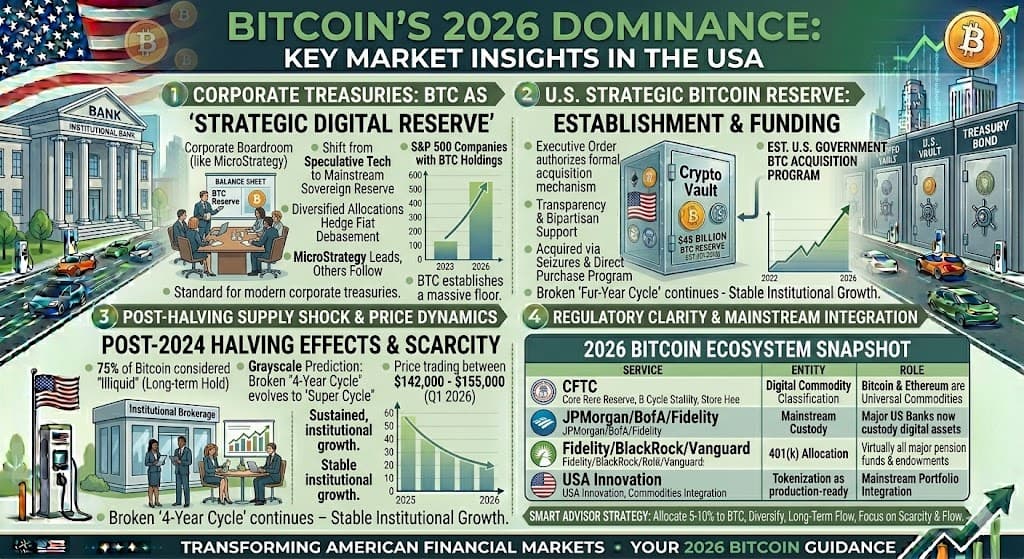
As of March 2026, the landscape of digital finance in the USA continues to be profoundly shaped by cryptocurrency, with Bitcoin firmly at its helm. This period marks a critical juncture for investors and enthusiasts alike, as the premier digital asset navigates a dynamic market while maintaining an undeniable grip on global financial attention. The current market situation reveals a robust, albeit volatile, environment where Bitcoin’s influence extends across institutional strategies, retail investment, and the broader FinTech ecosystem within the United States.
Understanding the immediate statistics and underlying trends is crucial for anyone engaging with or observing the digital asset space. This post delves into the most current, factual data surrounding Bitcoin’s performance, market capitalization, and its significant role in the American financial sector, offering a comprehensive snapshot of its status in early 2026.
Bitcoin’s Unwavering Market Dominance in March 2026
Bitcoin’s journey through 2026 continues to underscore its position as the undisputed leader in the cryptocurrency market. As of March, the digital asset showcases a remarkable stability within a specific price band, alongside an overwhelming market share that dwarfs its competitors. This sustained dominance is a testament to its foundational strength, widespread adoption, and growing integration into traditional financial frameworks across the USA.
Current Price and Volatility Snapshot
The current trading price for Bitcoin in March 2026 is projected to hover approximately between $70,000 and $74,000. This range reflects a period of consolidation following previous market movements, providing a clear benchmark for investors. Daily trading activity further illustrates this stability, with a typical 24-hour range fluctuating roughly between $69,000 and $71,000+. While daily price movements are inherent to any volatile asset, this relatively tight range suggests a degree of market maturity and established support levels.
It is important to contextualize these figures against past performance. Bitcoin’s all-time high, recorded in 2025, reached approximately $126,000. Comparing the current price to this peak highlights the natural ebb and flow of market cycles and the inherent risks associated with digital asset investment. Despite not being at its absolute peak, the current valuation remains significantly high, signaling sustained investor confidence and a strong underlying demand.
Market Capitalization and Dominance: A Trillion-Dollar Asset
Bitcoin’s sheer scale is best illustrated by its staggering market capitalization, which stands at approximately $1.4 trillion as of March 2026. This monumental figure not only solidifies its status as a major global asset but also underscores its influence over the broader crypto economy. Furthermore, Bitcoin accounts for over 55% of the total crypto market dominance. This statistic is critical, as it means that more than half of all value locked in cryptocurrencies resides within Bitcoin, making it the primary bellwether for the entire digital asset class.
This level of dominance has profound implications for the USA’s financial markets. Bitcoin’s movements often dictate the sentiment for altcoins, influencing investment strategies and risk assessments for both institutional and retail investors. Its robust market cap provides a foundation of liquidity and stability that attracts significant capital, further cementing its role as a premier investment vehicle in the American investment landscape.
Institutional Integration and Corporate Adoption in the USA
The narrative of Bitcoin in the USA is increasingly defined by its integration into institutional finance and corporate treasury strategies. This trend signifies a maturing market where digital assets are no longer fringe investments but are being recognized for their long-term value and potential as a hedge or growth asset.
Fidelity’s Influence and FinTech Evolution
The launch of initiatives such as the Fidelity Wise Origin Bitcoin Fund by major US asset managers like Fidelity is a significant indicator of this institutional shift. Such moves by established financial entities lend credibility and accessibility to Bitcoin, attracting a broader base of investors, including those who previously shied away from the perceived complexities of direct crypto investment. These developments enhance the reliability of future predictions and contribute to Bitcoin’s mainstream acceptance.
Moreover, Bitcoin is an integral component of the rapidly expanding FinTech ecosystem in the USA. FinTech cryptocurrency refers to digital assets like Bitcoin that leverage blockchain technology to enable decentralized transactions, digital payments, and innovative financial services without relying solely on traditional banking infrastructure. This technological paradigm shift is fostering new avenues for financial inclusion, efficiency, and innovation across the country, with Bitcoin serving as a prime example of its potential.
Companies like CoinZoom, a private US-based cryptocurrency exchange, exemplify this growth. While its exact valuation remains undisclosed, its platform supports diverse crypto trading, payment services, and crypto-linked cards, highlighting the expanding utility and presence of FinTech solutions in the American market.
Corporate Treasury Strategies: The Hyperscale Data Case Study
A tangible example of corporate adoption comes from Hyperscale Data, Inc. (NYSE American: GPUS), an artificial intelligence data center company anchored by Bitcoin. As of March 24, 2026, Hyperscale Data announced significant Bitcoin holdings, totaling approximately $42.6 million based on Bitcoin’s price of $67,845 on March 22, 2026. The company’s wholly-owned subsidiaries, Sentinum, Inc. and Ault Capital Group, Inc., collectively held 627.8970 Bitcoin.
This corporate strategy involves not only Bitcoin generated from mining operations but also Bitcoin acquired in the open market. Hyperscale Data’s intention to fully deploy cash allocated to its digital asset treasury into Bitcoin purchases over time underscores a growing trend among US corporations to integrate Bitcoin into their balance sheets. As of March 23, 2026, the company’s combined cash, restricted cash, and Bitcoin holdings of approximately $85.1 million represented about 147.07% of its current market capitalization. This aggressive stance highlights a belief in Bitcoin’s long-term value and its potential to strengthen corporate financial positions, providing a powerful real-world example of Bitcoin’s current impact on US-listed entities.
The Broader Cryptocurrency Landscape in March 2026
While Bitcoin commands the lion’s share of attention, the broader cryptocurrency market in the USA is a vibrant ecosystem with other digital assets playing significant roles. Their performance, however, is often correlated with Bitcoin’s movements, reinforcing its market leadership.
Key Altcoin Performance
As of March 2026, other notable cryptocurrencies exhibit varying price points:
- Ethereum (ETH): Trading around $2,133.29, Ethereum remains the second-largest cryptocurrency by market cap. Its robust ecosystem of decentralized applications (dApps) and smart contracts ensures its continued relevance, though its price point is significantly lower than its all-time high, mirroring the broader market’s fluctuations.
- XRP: Priced at approximately $1.4016, XRP maintains its position as a key player in cross-border payment solutions.
- Tether Gold (XAUT): Trading around $4,416.3, Tether Gold represents a stablecoin backed by physical gold, offering investors a digital asset pegged to a traditional safe-haven asset.
These figures provide a snapshot of the current valuations across major altcoins, illustrating the diverse opportunities and inherent volatility within the wider crypto market, all under the overarching influence of Bitcoin’s dominance.
Understanding Market Dynamics and Risk
The inherent volatility of the cryptocurrency market means that while there are significant potential rewards, there is always a risk of loss. No prediction framework is perfect, and market conditions can shift rapidly due to a multitude of factors, including regulatory changes, technological advancements, macroeconomic trends, and geopolitical events. For example, the value of $1 in Bitcoin as of March 2026 is approximately 0.000013–0.000014 BTC, based on Bitcoin trading around $70,000–$75,000. This highly fractional value demonstrates both Bitcoin’s high price point and the precise nature of its trading.
Factors impacting Bitcoin price forecasts include global economic conditions, technological developments, regulatory clarity (especially in the USA), institutional adoption rates, and overall market sentiment. Investors in the USA are increasingly looking for transparent and regulated pathways into digital assets, driving demand for compliant financial products and services.
The Current US Regulatory and Investment Environment
The United States continues to evolve its approach to cryptocurrency regulation, which significantly impacts market dynamics and investor confidence. As of early 2026, while a comprehensive federal framework is still developing, there is increasing clarity in certain areas, particularly concerning institutional involvement and consumer protection.
The regulatory landscape in the USA is a patchwork of state and federal initiatives, but the trend points towards greater oversight to foster investor safety and market integrity. This includes discussions around how digital assets are classified, tax implications, and anti-money laundering (AML) compliance. The involvement of major US financial institutions like Fidelity, as mentioned earlier, often comes with an expectation of adherence to existing financial regulations, pushing the crypto industry towards greater transparency and compliance.
For US investors, access to cryptocurrency is expanding through various channels, including regulated exchanges, Bitcoin ETFs, and corporate treasury holdings. This increased accessibility, coupled with ongoing educational efforts, is contributing to a more mature and informed investor base. The current situation reflects a market that is not just reacting to price movements but is also actively shaped by policy discussions and the actions of key industry players within the United States.
Conclusion: Bitcoin’s Enduring Relevance in the American Economy
As of March 2026, Bitcoin’s position as a dominant force in the global financial landscape, and particularly within the USA, is undeniable. With a projected price range of $70,000 to $74,000, a colossal $1.4 trillion market cap, and over 55% market dominance, Bitcoin continues to be the primary driver and indicator for the broader cryptocurrency market.
The increasing institutional adoption, exemplified by the Fidelity Wise Origin Bitcoin Fund and the strategic corporate treasury moves by US-listed companies like Hyperscale Data, signals a profound shift in how digital assets are perceived and integrated into traditional finance. The dynamic FinTech sector in the USA further amplifies Bitcoin’s utility, creating new avenues for decentralized finance and digital payments.
While market volatility remains a constant, the current data paints a picture of a resilient and influential asset. For investors and market observers in the USA, understanding these real-time facts and their implications is paramount for navigating the complex yet rewarding world of cryptocurrency in 2026. Bitcoin is not merely a digital currency; it is a foundational pillar of the evolving financial ecosystem, with its current status setting the stage for future developments and continued innovation.


