

The Shifting Landscape of the US Electric Automobile Market in 2026
The year 2026 marks a pivotal moment for the automobile electric car USA 2026 market, revealing significant shifts in consumer preferences and manufacturer strategies. While the narrative around electric vehicles (EVs) often centers on luxury models and large SUVs, recent data highlights an unexpected surge in smaller segments, redefining the growth trajectory of the American EV landscape. This dynamic environment is further shaped by substantial investments in domestic manufacturing, the evolving role of advanced technology, and strategic re-evaluations by major automakers.
B-Segment Leads the Charge with Unprecedented Growth
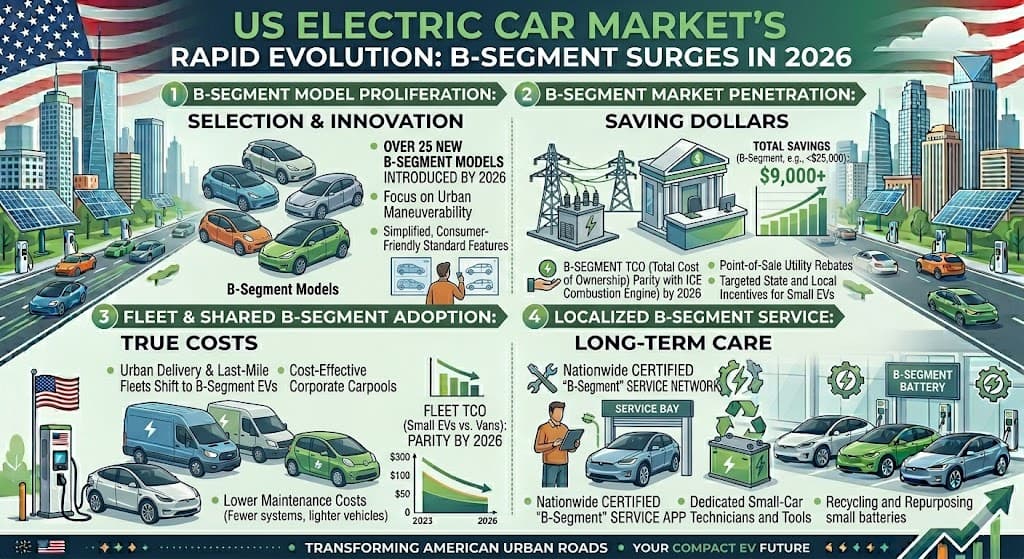
One of the most compelling developments in the U.S. electric vehicle market for 2026 is the explosive growth of the B-segment. This category, typically encompassing subcompact cars, has witnessed an astonishing +65% year-over-year growth. This surge indicates a growing appetite among American consumers for more compact, efficient, and potentially more affordable electric options. The traditional perception of the U.S. market being dominated solely by larger vehicles is being challenged, as practicality, urban maneuverability, and cost-effectiveness increasingly influence purchasing decisions. This rapid expansion in the B-segment suggests a maturing market, where EVs are no longer niche products but are becoming accessible and appealing to a broader demographic seeking solutions for daily commuting and city living.
The implications of this B-segment boom are far-reaching. For automakers, it signals a potential shift in product development priorities. Investing in and bringing more B-segment electric cars to the U.S. market could unlock significant sales volumes and market share. This trend could also alleviate concerns about charging infrastructure, as smaller EVs often require less battery capacity and are more likely to be charged at home or public Level 2 chargers, which are becoming increasingly prevalent in urban and suburban areas.
A-Segment Shows Promising Potential
While the B-segment captures headlines with its phenomenal growth, the A-segment also demonstrates considerable potential, with a +10% year-over-year growth globally. This segment, representing city cars, is being invigorated by new models from European brands such as Renault (with the Twingo), Dacia, and Smart (with the #2). While these specific models may not all be immediately available in the U.S., their emergence signifies a global trend towards smaller, highly efficient urban EVs. This global momentum could inspire or necessitate similar offerings from manufacturers targeting the U.S. market, especially as urban populations grow and demand for compact, easy-to-park, and environmentally friendly transportation solutions rises.
The expansion of city EVs, whether directly from these European brands or through U.S.-specific adaptations, could significantly broaden the appeal of electric cars in America. As more consumers become aware of the benefits of smaller EVs – from lower running costs to reduced environmental impact – the A-segment could become a crucial growth area. The question for the U.S. market remains whether OEMs will seize this opportunity to introduce a wider array of compact electric vehicles, catering to a segment of buyers potentially underserved by the current offerings.
The Unique American Demand: Pickup Trucks and the MPV Conundrum
The U.S. electric vehicle market continues to exhibit unique characteristics, particularly concerning vehicle body types. In the “Others” category, which encompasses a diverse range of vehicles, pickup trucks stand out, representing a substantial 7% of total electric vehicle sales. This figure underscores the enduring dominance and cultural significance of pickup trucks in the American automotive landscape. Unlike other major BEV markets where MPVs (Multi-Purpose Vehicles) typically make up the majority of sales in this “Others” category, the U.S. market’s preference for electric pickups is a clear differentiator.
The robust performance of electric pickup trucks highlights a successful adaptation of a beloved vehicle type to electric propulsion. Manufacturers who have introduced electric pickups have tapped into a significant segment of buyers who require the utility and versatility of a truck but are also keen on embracing sustainable transportation. This trend is likely to continue, with more electric pickup models expected to enter the market, offering increased competition and choice for consumers.
Conversely, the absence of electric MPVs in the U.S. market, with the Volkswagen ID.BUZZ being virtually the only electric MPV sold, raises pertinent questions. This stark contrast with other global markets, where MPVs are more common, prompts a critical inquiry: Is the lack of electric MPVs due to a genuine absence of buyer demand in the U.S., or is it a reflection of original equipment manufacturers’ (OEMs) strategic decisions not to prioritize or market such vehicles? The ID.BUZZ, while a niche offering, demonstrates that an electric MPV can exist, yet the broader market remains largely untapped. This situation suggests a potential missed opportunity for OEMs to cater to families or businesses seeking spacious, versatile electric alternatives to SUVs or vans, especially given the rising interest in electric mobility across all segments.
Strategic Investments and Technological Advancement in the USA
The evolution of the U.S. electric automobile market is not solely about sales figures; it’s also deeply rooted in strategic investments and technological innovation. Toyota, a major player in the global automotive industry, is reinforcing its commitment to the U.S. market with a significant investment of $1 billion in its Kentucky and Indiana plants. This substantial capital injection is earmarked for increasing the production of the Grand Highlander and, crucially, for manufacturing three new electric vehicles. This move by Toyota signals a strong belief in the long-term viability and growth of the U.S. EV market, promising more domestic job creation and a diversification of electric vehicle offerings for American consumers. Such investments are vital for building a robust domestic EV supply chain and manufacturing ecosystem, reducing reliance on international production, and bolstering the American economy.
Beyond manufacturing, the technological backbone of electric vehicles is rapidly advancing. Nvidia’s chips, for instance, are becoming central to autonomous driving systems due to their unmatched processing power. However, this power comes with challenges, particularly concerning heat management. Electric vehicles, with their inherent design flexibility and thermal management systems, are better equipped to integrate these sophisticated chips and their associated cooling requirements compared to traditional combustion-engine vehicles. This technological synergy positions EVs at the forefront of automotive innovation, enabling more advanced autonomous features, improved safety systems, and a more connected driving experience. The adoption of such cutting-edge technology will continue to differentiate electric cars in the USA, making them increasingly appealing to tech-savvy consumers.
Major Players Re-evaluating and Pivoting
The dynamic nature of the 2026 electric car market in the USA is also evident in the strategic adjustments and re-evaluations undertaken by global automotive giants. General Motors (GM), a quintessential American automaker, faces critical decisions regarding its global strategy. While its China comeback hinges on rapid Buick and Cadillac electrification as a 2027 contract deadline looms, these decisions have ripple effects on its overall EV portfolio and technology development, which ultimately impact its offerings in the U.S. market. A strong global EV strategy enables economies of scale and accelerates technological advancements that can then be deployed in its domestic market, enhancing the competitiveness of its American-bound electric vehicles.
Similarly, Kia’s vision for a larger, plusher 2027 Telluride underscores a broader industry trend towards upmarket offerings. The Telluride, a highly successful SUV in the U.S., is a testament to American consumer preference for spacious and premium vehicles. Kia’s strategy to move this model further upmarket, potentially with electrified variants, aligns with the evolving expectations of discerning U.S. buyers. This move suggests that while smaller segments are growing, there’s still a strong demand for larger, feature-rich vehicles, and OEMs are adapting their electrification strategies to meet these diverse consumer needs.
However, the journey towards electrification is not without its challenges. The news of Sony Honda Mobility canceling Afeela EVs and reviewing their joint venture amid costly Honda pullback and weak demand serves as a sobering reminder of the complexities involved. This decision highlights the significant financial commitments, technological hurdles, and market uncertainties that even well-resourced partnerships can face. For the U.S. market, this development means one less potential entrant in the burgeoning EV space, emphasizing the competitive intensity and the need for robust, well-executed strategies for any new electric automobile to succeed in America.
Global Context and the Unique American Market Structure
Understanding the U.S. electric vehicle market in 2026 also requires a brief look at its global counterparts. The European Union (EU) market structure, for instance, is largely compact-centric, with compacts being the main segment for Battery Electric Vehicles (BEVs). This structure could provide an advantage for local BEV makers in the EU, who have historically focused on smaller vehicles. The Chinese BEV market, on the other hand, presents a more balanced structure, with all categories holding at least a 13% share. This balanced distribution compels local players to maintain strong lineups across the size range, enabling them to export models to diverse markets, from city-car-friendly Italy to markets that favor full-size vehicles.
The U.S. market, however, maintains its distinct identity. While there’s a growing interest in smaller segments, the prevalence of pickup trucks and the demand for larger, more powerful vehicles remain defining characteristics. The CleanTechnica article also points out that while Chinese brands like AITOs and Li Autos could be targets for the U.S. market, geopolitical factors currently temper such purely free-market driven expansion. This highlights that the U.S. market’s evolution is not just a matter of consumer demand and technological progress but also a complex interplay of economic, political, and strategic considerations that shape which electric automobiles arrive on American shores and how quickly they gain traction.
In conclusion, the automobile electric car USA 2026 market is in a fascinating state of flux. The explosive growth of the B-segment signals a shift towards more diverse and accessible EV options, while the unique demand for electric pickup trucks reinforces American automotive culture. Strategic investments by companies like Toyota are bolstering domestic manufacturing and innovation, even as market challenges lead some ventures, like Sony Honda Mobility’s Afeela, to re-evaluate their strategies. As the market continues to mature, its evolution will be a testament to the interplay of consumer preferences, technological breakthroughs, and the strategic agility of automakers navigating a rapidly electrifying world.


