

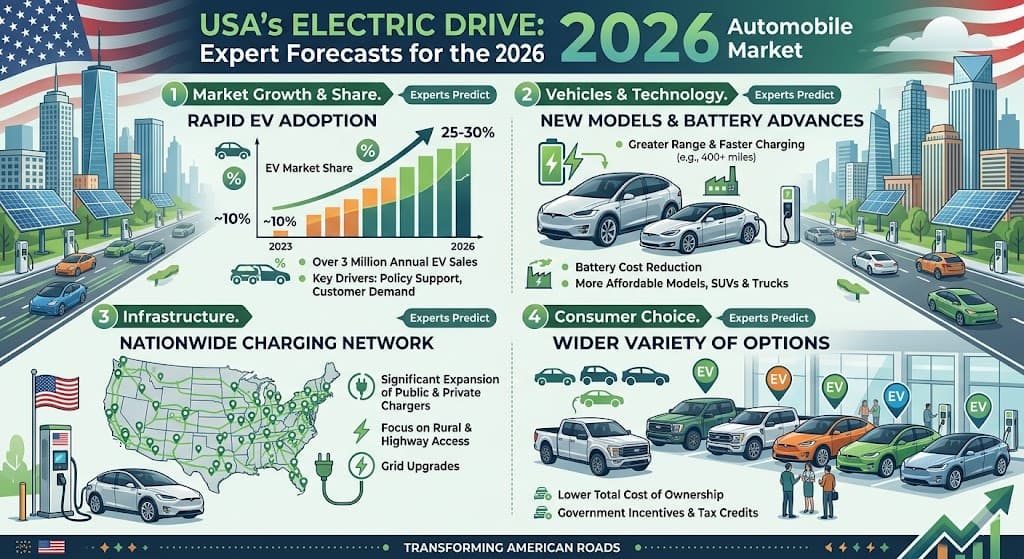
As we hurtle towards 2026, the landscape of the automobile electric car USA 2026 market is rapidly evolving, presenting a complex mosaic of innovation, infrastructure expansion, and market recalibration. This period is shaping up to be a critical juncture for electric vehicle (EV) adoption and the broader automotive industry in the United States. From significant advancements in charging networks to the strategic shifts of major automakers and the economic forces at play, understanding the predictions for 2026 requires a deep dive into expert analysis and emerging trends.
The transition to electric vehicles is not merely a technological shift; it’s a fundamental reshaping of consumer habits, infrastructure capabilities, and manufacturing priorities. By 2026, we anticipate a market characterized by both accelerating progress and the continued navigation of nascent industry challenges. This analysis will explore the key drivers and potential roadblocks that will define the American electric car experience in the near future.
The Backbone of Adoption: Charging Infrastructure by 2026
One of the most significant factors influencing the pace of EV adoption is the availability and reliability of charging infrastructure. Looking to 2026, the commitment to expanding this network is evident, particularly from industry leaders like Tesla. The latest developments indicate a strategic push to enhance EV travel capabilities across crucial regions.
Tesla’s Midwest and Southern Expansion: A Glimpse into the Future
By March 31, 2026, Tesla is set to significantly bolster its EV charging infrastructure in the USA. This expansion is concentrated in key locations across the Midwest and Southern states, directly addressing what has historically been a point of concern for potential EV buyers: range anxiety, especially on longer journeys. The installation of new fast chargers is a proactive measure designed to make electric travel more feasible and attractive for a wider demographic.
- Indiana’s Boost: A notable highlight of this expansion is Indiana, which will receive 10 new 240kW high-power chargers. These additions are not just numbers; they represent a substantial increase in charging speed and capacity, seamlessly integrating with and enhancing the existing public EV charging network. For drivers traversing the Hoosier State, this means less downtime and more efficient travel.
- Strategic Locations: Beyond Indiana, the rollout extends to several other vital areas. In Illinois, new chargers are slated for Vernon Hills, McHenry, and Terre Haute. Missouri will see installations in Parkville and Kearney. Further south, Blackwell in Oklahoma, Waco in Texas, and Little Rock in Arkansas are also targeted for these crucial infrastructure upgrades. This geographical spread is strategic, connecting major travel corridors and urban centers, thereby creating a more cohesive national charging grid.
This coordinated effort by Tesla signals a broader industry trend where investment in robust, high-speed charging is paramount. By 2026, such initiatives are expected to significantly mitigate range anxiety, making long-distance travel in an electric car a more commonplace and less stressful experience for American consumers. This infrastructure development is not just about convenience; it’s about building confidence in the EV ecosystem, laying the groundwork for sustained growth.
Technological Leap: What to Expect from 2026-Era EVs
Beyond infrastructure, the vehicles themselves are undergoing rapid evolution. The insights gleaned from early reviews of models like the 2027 Chevy Bolt, despite being a year out, offer a compelling preview of the technological trends that will define the 2026 market. We can anticipate significant strides in performance, efficiency, and integrated intelligence.
The 2027 Chevy Bolt: A Benchmark for Future Electric Cars
According to early critical reviews, the 2027 Chevy Bolt is poised to feature “more range, quicker charging and AI for a song.” These attributes are not isolated to one model but reflect broader industry directions:
- Extended Range: Battery technology continues to advance, promising greater mileage on a single charge. By 2026, we expect a wider array of EVs across price points to offer competitive ranges that easily meet the daily needs of most drivers and comfortably handle longer trips, further eroding range anxiety.
- Quicker Charging: Complementing the expansion of high-power charging stations, vehicles themselves are being engineered to accept higher charging rates. This synergy between vehicle and infrastructure will drastically reduce charging times, bringing the refueling experience closer to that of gasoline vehicles.
- Integrated AI and Smart Features: Artificial intelligence is set to become more integral to the driving experience. From advanced driver-assistance systems (ADAS) that enhance safety and convenience to personalized infotainment and predictive maintenance, AI will transform how drivers interact with their electric cars. Features like GM’s Super Cruise, mentioned in the context of future subscription models, hint at a future where autonomous capabilities become more sophisticated and widely available.
These technological advancements are crucial for driving consumer demand. As EVs become more capable, convenient, and intelligent, their appeal broadens beyond early adopters to the mainstream market. The continuous push for innovation will ensure that the automobile electric car USA 2026 market is not just growing in volume but also in the sophistication and desirability of its offerings.
Navigating Market Dynamics and Economic Realities
While the future of EVs looks promising, 2026 will also be a year of market adjustments and economic considerations. The industry is grappling with supply chain issues, evolving consumer demand, and the financial implications of a rapidly maturing market.
Fluctuating Demand and Production Pauses
The path to electrification is not without its bumps. Recent news indicates that GM has idled 1,300 workers as it pauses EV output in Detroit, citing waning demand. This phenomenon, while seemingly counterintuitive to the overall growth narrative, underscores a critical aspect of the 2026 market: the delicate balance between production capacity and actual consumer uptake. Factors contributing to these pauses can include:
- High Initial Costs: Despite incentives, the upfront cost of new EVs can still be a barrier for many consumers.
- Infrastructure Gaps: Even with expansion, perceived charging infrastructure gaps can deter buyers in certain regions.
- Economic Uncertainty: Broader economic pressures can lead consumers to delay large purchases like new vehicles.
By 2026, automakers will likely refine their production strategies to better align with market demand, possibly leading to more flexible manufacturing and a wider array of price points to capture a broader segment of buyers. The market will learn from these early adjustments, aiming for more stable growth.
The Looming Challenge of Depreciating Used EVs
A significant economic prediction for 2026 revolves around the used EV market. Experts warn that “depreciating used EVs are about to cost automaker finance companies billions of dollars.” As the first wave of EVs from the early 2020s hits the used car market, their resale values are proving to be less stable than traditional internal combustion engine (ICE) vehicles. This is due to several factors:
- Rapid Technological Advancements: Newer models often boast significantly improved range and charging speeds, making older models less attractive.
- Battery Degradation Concerns: While often overstated, consumer perceptions about battery health and replacement costs can impact resale value.
- Government Incentives for New EVs: Incentives often make new EVs more competitive against slightly older used models.
This challenge will require captive auto lenders and wholesale auctions to be “creative and adaptive.” Solutions might include innovative financing packages for used EVs, certified pre-owned programs with extended battery warranties, and new valuation models that better account for EV-specific attributes. For consumers, this could translate into more affordable entry points into EV ownership, further stimulating demand in the long run.
Geopolitical Tensions and Their Impact on EV Demand
External factors, particularly geopolitical events, are also predicted to play a significant role in shaping the 2026 EV market. The ChargePoint CEO’s statement that an “Iran war’s fuel price hike could drive EV demand” highlights the sensitivity of the automotive market to global events.
Fuel Prices as a Catalyst for Electrification
Historically, spikes in gasoline prices have consistently driven consumer interest in more fuel-efficient vehicles. In an era of escalating geopolitical tensions, the threat of disrupted oil supplies and subsequent fuel price hikes serves as a powerful reminder of the economic vulnerability associated with gasoline-powered cars. By 2026, should such scenarios materialize, the economic argument for switching to an electric car becomes even more compelling for a broader segment of the American populace.
This linkage means that while EV adoption is driven by environmental concerns and technological appeal, it can also be significantly accelerated by economic necessity. The inherent insulation of electric vehicles from fossil fuel price volatility offers a strategic advantage that could become increasingly vital in the coming years. This prediction underscores the multifaceted nature of EV adoption, where global events can exert a profound influence on domestic market trends.
The Evolving Business Model: Beyond the Sale
Automakers are not just focused on selling electric cars; they are strategically planning for long-term revenue streams that extend far beyond the initial purchase. By 2026, subscription services and software-defined vehicles are expected to fundamentally transform the automotive business model.
GM’s Vision: Subscriptions as a Future Revenue Driver
GM’s belief that OnStar and Super Cruise subscriptions will “fundamentally transform” its business offers a clear vision of the future. By 2026, we can expect a significant increase in subscription-based services across the EV spectrum. These could include:
- Advanced Driver-Assistance Features: Premium access to features like enhanced autonomous driving capabilities.
- Connectivity Services: In-car Wi-Fi, over-the-air updates, and integrated app ecosystems.
- Performance Upgrades: Potential for temporary or permanent software-based performance boosts.
- Personalized Experiences: Customization options for interior lighting, soundscapes, or even vehicle sounds.
This shift represents a move towards a recurring revenue model, offering automakers a more stable financial footing and potentially offsetting some of the high R&D costs associated with EV development. For consumers, it offers flexibility and the ability to customize their vehicle experience, though it also introduces new considerations regarding long-term ownership costs and data privacy.
Lessons from Abroad: China’s Influence and Mexico’s Pains
While the focus is on the USA, global trends and experiences offer valuable insights. The rapid expansion of Chinese brands and their “growing pains in Mexico” serve as a cautionary tale and a learning opportunity for the American market.
Scaling Up and Sustaining Quality
What U.S. dealers can learn from China’s rapid expansion is critical for the future of EV retail in America. The experience in Mexico, where dealers “rushed to sign Chinese brands during the pandemic but are growing more selective as customer service takes a back seat to sales,” highlights the importance of a holistic approach to market growth. By 2026, as EV sales continue to climb in the USA, maintaining high standards of customer service, after-sales support, and robust dealer networks will be paramount. A sales-first mentality without adequate support infrastructure can lead to long-term brand damage and consumer dissatisfaction.
For the automobile electric car USA 2026 market, this means:
- Investing in Training: Ensuring technicians are skilled in EV maintenance and repair.
- Robust Parts Supply Chains: Avoiding delays in repairs due to lack of specialized EV components.
- Customer Education: Guiding new EV owners through the charging process, range management, and unique vehicle features.
These lessons are vital for ensuring that the rapid growth of the EV market is sustainable and leads to positive long-term outcomes for both manufacturers and consumers.
Conclusion: A Transformative 2026 for the American Electric Car
The automobile electric car USA 2026 landscape is poised for significant transformation. Driven by ambitious infrastructure projects like Tesla’s expanded fast-charging network across the Midwest and South, coupled with continuous technological advancements in vehicle range, charging speed, and integrated AI, the fundamental barriers to EV adoption are steadily eroding. Consumers can look forward to a more capable and convenient electric driving experience.
However, 2026 will also be a period of critical market adjustments. Automakers will continue to refine their production strategies in response to evolving demand, while the financial implications of a burgeoning used EV market will necessitate innovative solutions from lenders and dealers. Geopolitical dynamics, particularly their impact on fuel prices, retain the potential to accelerate the transition to electric vehicles, underscoring their strategic importance for energy independence.
Ultimately, the American electric car market in 2026 will be defined by its resilience and adaptability. While challenges remain in balancing supply with demand, managing depreciation, and refining the customer experience, the overarching trajectory points towards continued growth and an increasingly dominant role for electric vehicles in the nation’s automotive future. The groundwork being laid today, from charging stations in Indiana to the AI features in upcoming models, suggests a vibrant and dynamic electric horizon for the United States.