

As the digital asset landscape continues its rapid evolution, the year 2026 stands as a pivotal period for cryptocurrency bitcoin USA 2026. The American market, a global hotbed for innovation and investment, is currently undergoing significant transformations driven by regulatory shifts, evolving market dynamics, and a growing understanding of digital assets’ place within the broader financial ecosystem. This analysis delves into the future predictions and expert insights shaping the trajectory of cryptocurrencies in the United States, offering a look at what investors, innovators, and everyday users can expect in this critical year.
From groundbreaking legislative proposals like the Clarity Act to landmark interpretations from regulatory bodies, the framework governing digital assets is becoming increasingly defined. Alongside these developments, major cryptocurrencies like Bitcoin continue their volatile dance, influenced by a complex interplay of macroeconomic policies and geopolitical events. This post unpacks these intricate factors, projecting their likely impact on the US crypto market throughout 2026 and beyond.
The Regulatory Crucible: Clarity Act and Stablecoin’s Future
The regulatory environment is arguably the single most influential factor shaping the future of cryptocurrency in the USA. In 2026, the legislative spotlight shines brightly on the Clarity Act, a proposed bill that could fundamentally alter the stablecoin landscape.
The Looming Shadow of the Clarity Act
The Clarity Act, a legislative initiative aiming to ban stablecoin yields, has been steadily progressing through the halls of Washington. A version of this bill successfully passed the House of Representatives last year, demonstrating a bipartisan intent to address perceived risks associated with yield-generating stablecoin products. Further cementing its momentum, the bill advanced from a Senate Agriculture Committee markup hearing in January 2026. The next crucial hurdle lies with the Senate Banking Committee, where a markup hearing is anticipated in late April. The outcome of this hearing will be instrumental in determining the bill’s path to the Senate floor and, ultimately, to becoming law.
The very prospect of the Clarity Act’s passage has sent ripples of uncertainty through the crypto market, particularly impacting stablecoin issuers and related entities. Companies like Circle, a prominent stablecoin issuer, have felt the immediate brunt of this legislative uncertainty. As of March 23, 2026, Circle’s stock unraveled by approximately 19%, undercutting its 21-day moving average. While the company’s shares were still up 33% year-to-date, this sharp decline underscores investor apprehension regarding future revenue models if yield generation is prohibited.
The ripple effect extended to other major crypto platforms. Coinbase, a bellwether for the broader crypto market, saw its stock dive 9%, falling below its 50-day line and marking an 18% decline for the year. Similarly, Bullish retreated almost 5%, flipping negative on the year, and Gemini stock fell more than 8%, extending its 2026 drop to a staggering nearly 47%. These figures are not merely transient market fluctuations; they represent a tangible response to the potential restructuring of a significant segment of the crypto economy. Investors are clearly adjusting their valuations based on the anticipated impact on business models reliant on stablecoin yield offerings, which have been a cornerstone of many DeFi protocols and lending platforms.
Stablecoins Beyond Yields: Adapting to a New Landscape
Should the Clarity Act pass in its current form, banning stablecoin yields, the stablecoin industry in the USA will face a critical juncture. While the immediate impact on profitability for some issuers could be significant, it’s crucial to consider the broader utility of stablecoins beyond speculative yield farming. Stablecoins serve as vital tools for payments, remittances, and as a stable on-ramp and off-ramp for the volatile crypto market. Their role in facilitating cross-border transactions and providing a reliable store of value within the digital ecosystem is undeniable.
Expert analysis suggests that a post-Clarity Act world would necessitate a strategic pivot for stablecoin issuers operating in the USA. Instead of relying on yield generation, companies might focus more intensely on enhancing the stability, transparency, and regulatory compliance of their stablecoin offerings. This could involve stricter audits, clearer reserve attestations, and integration with traditional financial systems to foster greater institutional adoption for payment and settlement purposes. Innovation might shift towards developing non-yield-bearing stablecoin applications, such as enhanced enterprise solutions or more efficient retail payment systems.
There’s also the possibility that some stablecoin projects might adapt by offering yield-generating products in jurisdictions outside the USA, catering to international demand while maintaining a compliant, yield-free offering for the American market. This bifurcated approach could allow companies to navigate the fragmented global regulatory landscape. Ultimately, the Clarity Act, while potentially disruptive, could force the stablecoin sector in the USA to mature, focusing on fundamental value propositions and robust regulatory adherence, thereby potentially strengthening its long-term viability and integration into mainstream finance.
A Watershed Moment: SEC/CFTC Joint Interpretation and Legal Clarity
Complementing the legislative efforts, a significant development in regulatory clarity emerged from the combined efforts of the Securities and Exchange Commission (SEC) and the Commodity Futures Trading Commission (CFTC). This joint interpretation marks a pivotal moment in how digital assets are understood and regulated in the USA.
Defining Digital Assets: A Unified Framework Emerges
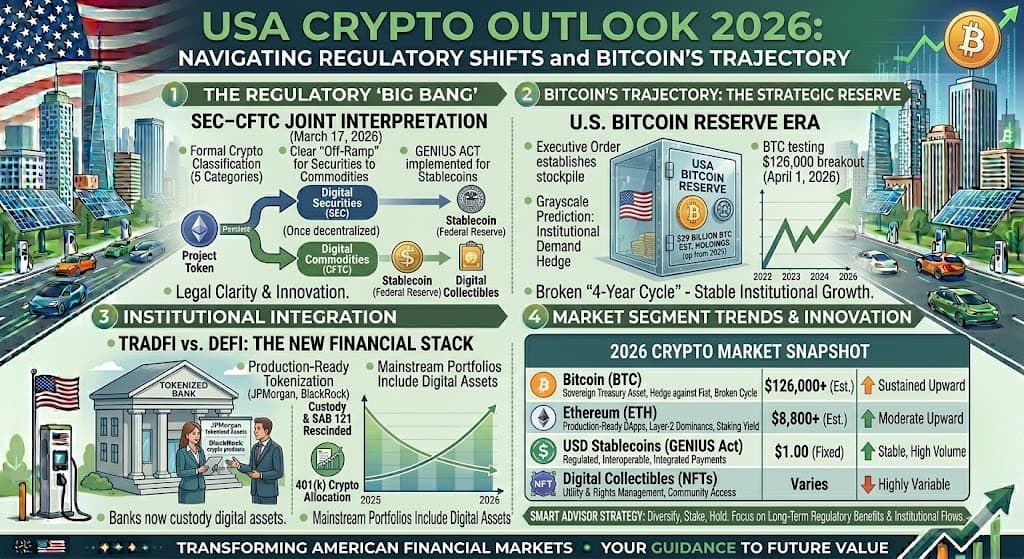
On March 17, 2026, the SEC and CFTC jointly issued an interpretive release, a landmark document addressing the classification of crypto assets and the application of federal securities laws to crypto asset transactions. This release, part of the agencies’ coordinated efforts under “Project Crypto,” is intended to provide a unified framework for analysis, significantly reducing the ambiguity that has long plagued the industry. In accompanying public statements, the SEC explicitly described the release as recognizing that “most crypto assets are not themselves securities.”
This statement represents a profound shift in emphasis. Historically, many within the crypto space have grappled with the ‘security vs. commodity’ debate, often leading to regulatory uncertainty and apprehension. The joint interpretation now clearly distinguishes between the crypto asset itself and the circumstances under which it may be offered or sold as part of an investment contract. This distinction is critical, as it implies that while an asset like Bitcoin or Ethereum might not inherently be a security, specific offerings or sales of that asset could still fall under securities laws if they meet the criteria of an investment contract, primarily the Howey Test.
The interpretation leaves the foundational Howey Test fully intact but reshapes its application for digital assets. It moves away from a blanket classification of crypto assets as securities and instead focuses on the specific “structure and communication” surrounding an offering. For market participants, this means that “labels and technology will matter less than structure and communication,” and these choices will increasingly determine where securities law in the crypto sector begins and ends. This nuanced approach promises to provide much-needed clarity, allowing projects to design their offerings with a clearer understanding of their regulatory obligations.
The Path Forward for Innovation and Investment
The SEC/CFTC joint interpretation is poised to be a game-changer for innovation and investment in the USA’s crypto sector. By clarifying that most crypto assets are not intrinsically securities, the agencies have provided a clearer path for developers and entrepreneurs. This newfound clarity could reduce the regulatory overhang that has sometimes stifled innovation, encouraging more projects to build and launch within the US, rather than seeking more permissive offshore jurisdictions.
For institutional investors, this framework offers a significant reduction in regulatory risk. Greater certainty regarding the classification of assets makes it easier for traditional financial institutions to evaluate, custody, and offer crypto products and services. This could unlock substantial institutional capital, leading to increased liquidity and market depth for compliant digital assets. The distinction between an asset and its offering also provides a blueprint for how to structure sales and distributions of crypto assets to avoid triggering securities laws, or conversely, to comply with them when appropriate.
Expert analysis suggests this unified framework will foster a more robust and compliant crypto ecosystem in the USA. It encourages a proactive approach to regulatory adherence, where projects prioritize transparent communication and carefully structured offerings. This could lead to a ‘flight to quality,’ where well-structured and compliant projects gain a competitive advantage, attracting more legitimate investment and user adoption. The long-term implication is a more mature and integrated digital asset market that can coexist and interact seamlessly with traditional finance, ultimately benefiting both sectors and bolstering the USA’s position as a leader in the global crypto economy.
Bitcoin, Geopolitics, and Macroeconomics: Forecasting Market Trajectories in 2026
Beyond regulatory shifts, the price trajectory of Bitcoin and other major cryptocurrencies in 2026 remains highly susceptible to global macroeconomic forces and geopolitical developments. These external factors often dictate market sentiment and investor behavior, leading to significant price movements.
Bitcoin’s Volatile Dance: $70,000 Threshold and Beyond
Bitcoin’s performance in early 2026 has been a testament to its inherent volatility and sensitivity to external pressures. The cryptocurrency briefly slid back below $70,000 on March 23, 2026, after rebounding above that level just a day prior. This fluctuation was influenced by broader macroeconomic concerns, specifically the “higher-for-longer policy” mantra adopted by central banks, indicating sustained high interest rates that weigh on risk assets. Additionally, an “oil-fueled retreat” also contributed to its dip, showcasing its interconnectedness with global commodity markets and inflationary pressures.
However, Bitcoin also demonstrated its unique resilience and responsiveness to geopolitical shifts. On the very same day, Bitcoin price rallied significantly after President Donald Trump paused strikes against Iranian energy infrastructure for five days. This event caused gold and oil futures to fall, while Bitcoin surged, highlighting its growing role as an alternative asset class that can react differently to geopolitical events compared to traditional safe havens or commodities. Sometimes acting as a risk-on asset, sometimes demonstrating safe-haven characteristics, Bitcoin’s response matrix is becoming increasingly complex.
Forecasting Bitcoin’s trajectory for the remainder of 2026 requires considering several interwoven factors. Continued regulatory clarity from the SEC/CFTC interpretation could provide a fundamental tailwind, attracting more institutional inflows as investment committees gain confidence. Conversely, the uncertainty surrounding the Clarity Act and its potential impact on stablecoins could create headwinds, especially if it dampens overall crypto market sentiment. Macroeconomic factors like inflation rates, interest rate policies, and global economic growth will continue to exert significant influence. Should central banks pivot towards more accommodative policies, Bitcoin, as a risk asset, could benefit. Geopolitical stability, or the lack thereof, will also play a crucial role, with Bitcoin potentially reacting sharply to major global events.
Crypto Stocks and the Broader Market Ripple Effect
The performance of publicly traded crypto-related companies serves as a barometer for market sentiment and investor confidence in the digital asset space. As noted earlier, early 2026 saw significant declines in major crypto stocks like Circle (-19%), Coinbase (-9%), and Gemini (-47% YTD). These movements are not just isolated incidents; they reflect the deep connection between regulatory uncertainty, investor apprehension, and the broader market’s perception of crypto’s future.
Expert analysis suggests that if regulatory clarity improves and the Clarity Act’s final form is less severe than initially feared, or if alternative business models emerge, these stocks could see a rebound. Conversely, a highly restrictive Clarity Act or renewed regulatory ambiguity could exacerbate their downward trend. The performance of these companies will also be tied to Bitcoin’s price movements and the overall health of the crypto market. Strong Bitcoin performance, coupled with increased trading volumes and user adoption, typically translates to better financial results for exchanges and service providers.
Comparing this to the traditional safe-haven asset, gold, provides an interesting contrast. The gold price surged above $4,500 on March 25, 2026, extending gains as Middle East tensions eased. While gold traditionally rises during geopolitical uncertainty, its recent surge as tensions eased could indicate a broader shift in investor sentiment, perhaps moving away from pure safe-haven plays towards broader market optimism or inflation hedges. Bitcoin’s occasional correlation and occasional divergence from gold highlight its evolving role in diversified investment portfolios, increasingly recognized as an asset with unique properties influenced by both traditional and digital-native drivers.
The Investment Landscape: Opportunities and Challenges for USA Investors in 2026
For investors in the USA, 2026 presents a dynamic landscape filled with both significant opportunities and notable challenges. Navigating this environment successfully will require a nuanced understanding of the evolving regulatory framework and market forces.
Navigating New Regulatory Waters
The dual impact of the Clarity Act (potential constraint on stablecoin yields) and the SEC/CFTC joint interpretation (providing legal clarity on asset classification) creates a unique investment climate. On one hand, the potential ban on stablecoin yields could reshape the DeFi sector, pushing investors to re-evaluate strategies reliant on such returns. On the other hand, the explicit recognition that “most crypto assets are not themselves securities” significantly de-risks the broader market by reducing the threat of retroactive enforcement actions against a vast array of digital assets.
Expert perspective emphasizes the importance of due diligence on projects’ structure and communication. Investors should scrutinize how new crypto projects are designed, how their tokens are offered, and the transparency of their operations to ensure compliance with the emerging regulatory framework. This focus on “structure and communication” will be paramount, shifting the investment thesis from purely technological innovation to a blend of technology and regulatory foresight. The clarity provided by the SEC/CFTC is a boon for long-term investors, as it lays the groundwork for more predictable regulatory outcomes and potentially greater mainstream adoption.
Future of Digital Assets: Beyond Bitcoin and Stablecoins
While Bitcoin and stablecoins often dominate headlines, the broader digital asset ecosystem in the USA is also poised for significant growth and diversification in 2026. The new regulatory framework, which distinguishes between an asset and its offering, will apply to a wide range of cryptocurrencies, including major altcoins like Ethereum and countless smaller projects. This framework should provide a clearer pathway for these assets to operate and innovate within a compliant environment, fostering growth in areas such as Web3 infrastructure, decentralized applications (dApps), and non-fungible tokens (NFTs).
A notable trend to watch is the continued convergence of traditional finance with digital assets. The mention of Nasdaq launching tokenized stocks, though in a headline, hints at a future where traditional equities and other real-world assets are represented on blockchain rails. This movement towards tokenized assets could unlock new efficiencies, enhance liquidity, and broaden access to investment opportunities, creating a hybrid financial system that leverages the best of both worlds. This signifies a major step towards the maturation and integration of digital assets into the mainstream financial infrastructure of the USA.
Overall, 2026 for the US crypto market is expected to be a year of increased institutional participation, driven by enhanced regulatory clarity and a more defined operational landscape. While some consolidation of non-compliant projects might occur, the overarching trend points towards a more sophisticated, regulated, and robust digital asset market. Investors who prioritize compliance, understand the evolving regulatory nuances, and conduct thorough research will be best positioned to capitalize on the significant opportunities presented by this transformative period.
Conclusion
The landscape for cryptocurrency bitcoin USA 2026 is characterized by a dynamic interplay of legislative action, regulatory clarity, and global economic forces. The progression of the Clarity Act underscores the US government’s intent to shape the stablecoin market, potentially ushering in an era where utility, rather than yield, becomes the primary focus. Simultaneously, the landmark joint interpretation by the SEC and CFTC provides unprecedented clarity, recognizing that most crypto assets are not securities, thereby de-risking the broader market and fostering an environment ripe for compliant innovation and institutional investment.
Bitcoin’s journey through 2026 will continue to be a compelling narrative, influenced by everything from domestic monetary policy to international geopolitical events. Its resilience and unique response patterns solidify its position as a critical, albeit volatile, component of the global financial system. For investors and market participants in the USA, understanding these converging forces is paramount. The year promises continued maturation of the digital asset space, moving towards greater integration with traditional finance and a more defined regulatory framework. Navigating these waters with foresight and adaptability will be key to unlocking the immense potential that cryptocurrencies offer in the American market.

