


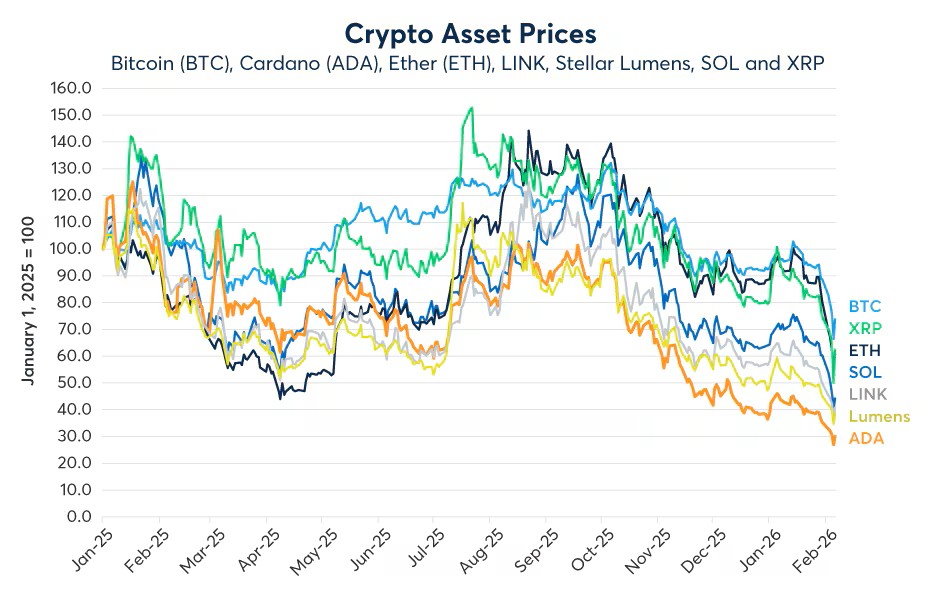
After reaching highs between July and October 2025, cryptocurrency prices have dropped sharply. Since January 1, 2025, even the top-performing digital asset, Bitcoin (BTC), has declined about 26% as of February 12, 2026. Meanwhile, Cardano (ADA) has been the weakest performer, plunging more than 70%.
Overall, most major crypto assets have fallen between 30% and 70% since early 2025.
Why the Selloff Is Surprising
The downturn is puzzling when viewed against the broader macroeconomic backdrop. Many investors assume that cryptocurrencies:
- Move in the same direction as precious metals
- Move opposite to the U.S. dollar
- Track technology stocks higher
However, reality has proven more nuanced.
Over the past year, precious metals have rallied strongly despite recent pullbacks. The U.S. dollar has weakened against most major currencies. At the same time, U.S. equities—especially tech shares—have delivered solid gains since early 2025. Yet cryptocurrencies have struggled.
Crypto vs. Gold and the U.S. Dollar
The relationship between crypto assets and gold has never been as strong as commonly believed. During 2020 and 2021, when the Federal Reserve pursued aggressive quantitative easing, Bitcoin and other tokens showed a modest positive correlation with gold. Even then, rolling 12-month correlations rarely exceeded +0.41. Since 2024, that relationship has largely faded toward zero.
A similar pattern appears when comparing crypto to the Bloomberg Dollar Index. In 2022 and 2023, cryptocurrencies often moved inversely to the dollar, with correlations reaching around -0.4. But by 2025 and early 2026, that inverse relationship weakened substantially. As a result, rising metal prices and a softer dollar have not translated into gains for crypto markets.
Strong Link to Tech Stocks
The equity relationship is harder to dismiss. Since 2020, crypto assets have generally maintained a positive correlation with the Nasdaq-100. Correlations have ranged from weak (+0.1 or +0.2) to moderate (+0.35 to +0.6), particularly during 2025 and early 2026.
This suggests that when U.S. tech stocks rise, crypto tends to follow—though often by a smaller margin. Conversely, during tech selloffs, cryptocurrencies frequently fall harder than equities.
Regulatory Tailwinds Didn’t Prevent the Decline
The policy environment in the United States has been relatively supportive of digital assets, with an administration that openly embraces the sector. Combined with positive macro conditions, this should have favored crypto prices.
One explanation may be the massive rally in late 2024, which likely priced in expectations of regulatory improvements. Even accounting for that surge, only Stellar Lumens (XLM), Bitcoin, and XRP have posted gains since early 2024. Others, such as Ethereum (ETH) and Chainlink (LINK), have declined between 40% and 50%.
Bitcoin’s Dominance Over the Sector
The key factor may be Bitcoin itself. Among all major cryptocurrencies with futures markets, correlations with BTC remain extremely high. Over the past year, most tokens have shown correlations between +0.7 and +0.82 with Bitcoin.
While XLM and XRP occasionally display weaker ties, most other coins historically move in the +0.6 to +0.8 range relative to BTC. This indicates that crypto’s weakness may stem less from external conditions and more from internal dynamics—specifically Bitcoin’s performance.
What’s Happening Inside Bitcoin?
Bitcoin’s core value proposition is scarcity. Often described as “digital gold,” its supply is capped at 21 million coins. Roughly every four years, Bitcoin undergoes a “halving,” cutting the rate of new supply creation by about 50%.
Following the first three halvings, Bitcoin prices surged dramatically—ranging from 290% to 8,500% in the subsequent year. However, after the fourth halving in April 2024, prices failed to produce a similar breakout.
Several structural issues may explain this shift.
Network Growth Has Slowed
In Bitcoin’s early years, daily transactions expanded rapidly. By late 2017, however, transaction growth plateaued. Although ETF launches in 2024 briefly boosted volumes, activity slipped back in 2025.
Rising Mining Complexity
The computational difficulty required to mine Bitcoin has increased significantly. The current block reward stands at 3.125 BTC, and miners must perform roughly 141 trillion calculations to produce a single coin. This requires enormous energy and computing resources.
High Transaction Costs
Blockchain transaction fees have ranged between $70 and $300 in miner revenue per transaction. Historically, spikes in transaction costs often preceded market downturns. Prior to the recent peak, fees rose again, foreshadowing the latest decline. Recently, costs have fallen—levels that in the past sometimes preceded temporary recoveries.
Limited Speed and Scalability
Bitcoin’s blockchain remains relatively slow. Transactions typically take 30 to 60 minutes for confirmation, though times can vary widely. At peak capacity, Bitcoin processes about 10.5 transactions per second, with typical rates closer to 3–7. Before the latest selloff, throughput fell toward 2.5 transactions per second.
Faster Blockchains Still Follow Bitcoin
Interestingly, other cryptocurrencies operate much faster networks with quicker finality times. For example:
- Solana (SOL) offers near-instant transaction speeds.
- XRP enables rapid cross-border settlement for institutions.
- Ethereum supports smart contracts and tokenized assets.
Despite these advantages, when Bitcoin weakened in late 2025, most alternative tokens declined even more sharply.
One reason may be volatility. Bitcoin’s one-year realized volatility during 2025 hovered around 30–40%. Other cryptocurrencies typically exhibited volatility between 60% and 100%. With higher volatility and strong correlation to BTC, it’s not surprising that alternative tokens experienced deeper drawdowns.
If crypto markets rebound, these same tokens could potentially outperform Bitcoin on the upside, just as they have during previous recovery phases.
Can Crypto Decouple From Bitcoin?
Many cryptocurrencies now serve distinct real-world purposes:
- XRP functions as a bridge for institutional currency transfers.
- Ethereum powers smart contracts and tokenized financial products.
- Solana competes with payment networks on processing speed.
- Chainlink connects traditional finance systems to blockchain networks.
- Stellar focuses on low-cost global remittances.
- Cardano supports digital identity and governance applications.
Given their diverse use cases, a key question remains: could one of these assets eventually break free from Bitcoin’s dominance and establish independent price leadership? Or will Bitcoin’s scarcity-driven narrative continue to anchor the entire crypto market?
For now, the evidence suggests that the crypto sector still moves largely in Bitcoin’s wake.