

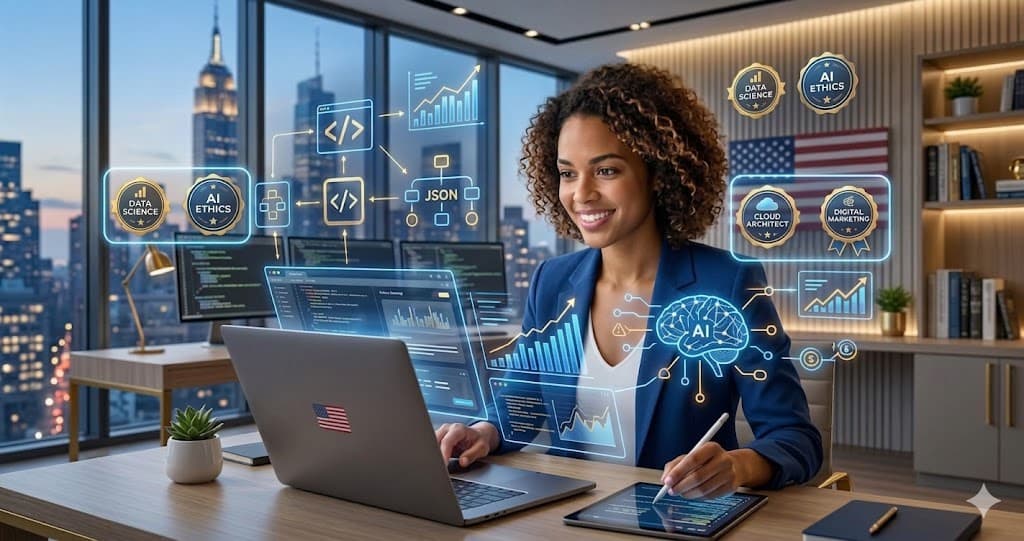
Online Education USA 2026: Future-Proofing Skills for Tomorrow’s Workforce
As we look towards online education USA 2026, the landscape of learning is rapidly transforming, driven by technological advancements and an urgent demand for a future-ready workforce. Recent initiatives, such as the U.S. Department of Labor’s (DOL) pioneering “Make America AI-Ready” course, underscore a profound shift: education is becoming more accessible, agile, and directly aligned with economic imperatives. This evolution isn’t just about new tools; it’s about fundamentally rethinking how Americans acquire the skills needed to thrive in an increasingly automated and interconnected world, making online platforms central to this strategic national endeavor.
The Dawn of Accessible AI Literacy: A New Era for Online Education
The launch of the DOL’s “Make America AI-Ready” program in 2026 marks a pivotal moment, signaling a new paradigm for foundational skills training through online education. This free, seven-day course, delivered via text message, is a masterclass in accessibility-first design. It requires no laptop or internet access, delivering short, daily lessons that participants can complete in about 10 minutes. This mobile-first, low-barrier approach is not merely convenient; it represents a strategic move to democratize crucial AI literacy skills across the broadest possible spectrum of the American workforce.
Federal policymakers are increasingly asserting that AI literacy is foundational to effective workforce participation. The DOL’s initiative, explicitly part of President Donald Trump’s larger AI Action Plan for “rapid retraining” and integrating AI skill development into various programs, validates this perspective. For online education providers, this translates into a clear mandate: design courses that meet learners where they are, acknowledging diverse technological access and time constraints. Organizations that fail to embrace accessible, foundational AI enablement risk exacerbating capability and engagement gaps within their workforces, making inclusive online learning solutions indispensable.
Microlearning and Mobile-First: The Future is Bite-Sized
The success model of “Make America AI-Ready” is deeply rooted in microlearning principles and a mobile-first philosophy. The delivery of short, daily lessons via text messages epitomizes the effectiveness of breaking down complex topics into digestible, manageable chunks. This approach combats information overload and facilitates consistent engagement, a critical factor for adult learners balancing work and personal commitments. For the future of online education in the USA, this signals a clear trend: platforms that can deliver high-impact, bite-sized content adaptable to mobile devices will lead the market. Learners are no longer confined to traditional classroom settings or even desktop computers; their smartphones are becoming their primary learning portals, demanding intuitive, responsive, and efficient educational experiences.
This shift extends beyond just convenience. Mobile-first design inherently supports learning on the go, making it easier for individuals to integrate skill development into their daily routines—during commutes, lunch breaks, or brief moments of downtime. The implications for educational content creation are profound, emphasizing conciseness, visual appeal, and interactive elements that function seamlessly on smaller screens. Online education providers must invest in robust mobile platforms, responsive design, and content optimized for quick consumption, transforming the learning experience from a dedicated event into an integrated part of everyday life.
Bridging the Digital Divide with Foundational Skills
One of the most significant contributions of initiatives like “Make America AI-Ready” to online education in the USA is its direct impact on bridging the digital divide. By eliminating the need for expensive hardware or high-speed internet, the course makes essential AI literacy accessible to populations traditionally excluded from advanced technological training. This democratizes opportunities, ensuring that foundational skills are not a privilege but a universal right, crucial for economic mobility and social equity.
The course serves as an entry point, directing participants to more advanced resources based on their goals, illustrating how foundational online education can act as a crucial first step in a longer learning journey. This multi-tiered approach—starting with accessible basics and then guiding learners to more specialized training—is a model that online education providers can emulate to build comprehensive, inclusive learning ecosystems. By prioritizing universal access to foundational digital skills, the online education sector can play a vital role in empowering every American to participate meaningfully in the evolving economy, ensuring that no one is left behind in the rapid pace of technological change.
Reshaping Career Pathways: AI Integration and Skilled Trades
The DOL’s push for AI skill-building to be embedded into career pathways, not just offered as standalone training, signifies a profound recalibration of workforce development. This strategic approach recognizes that AI is not a niche technology but a pervasive force impacting every industry and job function. Consequently, online education platforms must evolve to integrate AI literacy and specialized AI skills directly into diverse vocational and professional training programs, aligning with the broader mandate for “rapid retraining” of workers.
While AI dominates headlines, the importance of skilled trades remains undiminished, evolving in parallel with technological advancements. The Build My Future Construction Showcase, drawing Ozarks students to a skilled trades event with 67 hands-on exhibits, highlights the ongoing demand for practical, tangible skills. The future of online education USA 2026 lies in its ability to complement and enhance such hands-on learning experiences. Online modules can provide foundational theoretical knowledge, safety certifications, project management principles, and even augmented reality simulations that prepare students for the physical demands and complexities of skilled trades, creating a powerful hybrid learning model.
The Hybrid Model: Blending Digital and Hands-On Learning
The synergy between online education and hands-on vocational training is a powerful predictor for future workforce development. While the Build My Future Construction Showcase emphasizes physical engagement, online platforms can serve as invaluable preparatory tools. Imagine online modules teaching blueprint reading, material science, or even virtual simulations of welding techniques before students step into a workshop. This hybrid model allows for scalability, consistency in foundational instruction, and a more efficient use of expensive hands-on resources.
Furthermore, online education can extend the reach of skilled trades training beyond geographical limitations. Remote students can access high-quality theoretical instruction, engage in interactive quizzes, and even participate in virtual reality (VR) or augmented reality (AR) environments that simulate real-world construction scenarios. This blend ensures that while the tactile experience remains critical, the accessibility and adaptability of online learning can prepare a broader, more diverse pool of talent for the skilled trades, addressing critical labor shortages and ensuring a robust infrastructure for the nation.
AI’s Impact on Traditional Roles: A Call for Continuous Online Upskilling
The accelerating pace of AI-driven change is not just creating new jobs; it’s fundamentally altering existing ones. Insights from SHRM confirm that job postings for HR positions increasingly mention artificial intelligence and machine learning skills, often more frequently than the wider U.S. labor market. This trend is symptomatic of a broader phenomenon: no industry or profession is immune to AI’s transformative power, leading to a significant demand for continuous online upskilling and reskilling.
For professionals in traditional roles, online education becomes an indispensable tool for career longevity and growth. Whether it’s HR professionals learning AI-powered analytics tools, marketing teams mastering AI-driven content creation, or financial advisors leveraging AI for predictive modeling, the need to adapt is constant. Online platforms offer the flexibility and targeted content necessary for busy professionals to acquire new competencies without disrupting their careers. This continuous learning imperative underscores the critical role of online education providers in equipping the existing workforce with the adaptive skills needed to navigate an AI-augmented professional landscape, minimizing the risk of job displacement and maximizing productivity.
Cultivating a Culture of Continuous Learning: The Core of Future Workforce Readiness
Workforce transformation, as articulated in expert analysis, fundamentally begins with culture. Leaders across sectors must unequivocally signal that continuous learning is not a luxury but a core expectation of every role. Integrating skills development into performance reviews, goal setting, and recognition programs reinforces this commitment, making learning an intrinsic part of professional growth. In this environment, online education emerges as the most flexible and scalable solution for fostering such a culture, providing the tools and pathways for ongoing development.
The best practices for sustainable cross-skilling, critical for future-proofing any workforce, heavily rely on accessible and practical learning mechanisms. Time constraints are a universal reality, especially for public-sector employees and busy professionals. Therefore, online learning programs must be designed with flexibility and manageability in mind. Microlearning modules, project-based training, and on-demand sessions are not just convenient; they are essential for allowing staff to seamlessly integrate learning into their daily workflow, turning every moment into a potential learning opportunity.
Practical and Accessible Learning: The Mandate for Online Providers
The call for practical and accessible learning is a direct challenge to online education providers. They must move beyond static content delivery to offer dynamic, engaging, and immediately applicable training. This means prioritizing:
- Microlearning Modules: Short, focused lessons that can be consumed quickly and on various devices.
- Project-Based Training: Opportunities for learners to apply new skills to real-world scenarios, fostering deeper understanding and practical competence.
- On-Demand Sessions: Flexibility for learners to access content when and where it suits them best, accommodating diverse schedules and learning paces.
- Interactive Elements: Quizzes, simulations, and collaborative tools that enhance engagement and retention.
Leading platforms, exemplified by providers like Pluralsight, are already demonstrating this approach. They offer comprehensive tech skills platforms that enable organizations to assess skill gaps, then provide broad and deep training across domains like cybersecurity, cloud, and AI. This includes highly curated content, virtual instructor-led training, hands-on labs, and skill assessments, empowering leaders with data-driven insights to align skill development with strategic objectives. The future of online education demands this level of intentional design, ensuring that learning is not just consumed but actively applied and measured for impact.
Strategic Partnerships and Data-Driven Skill Development
Effective cross-skilling and workforce development in 2026 will heavily rely on intentional planning, cultural reinforcement, and, crucially, measurable progress. Agencies and organizations must align learning pathways to real operational needs, provide employees with practical opportunities to apply new skills, and meticulously track growth. This necessitates a shift from disconnected training sessions to a sustainable, mission-aligned workforce strategy that evolves alongside technology and mission priorities.
Choosing the right strategic partner is paramount. These partners help transform skills development into a continuous, data-driven process. They offer sophisticated analytics to identify existing skill gaps, recommend personalized learning paths, and measure the ROI of training initiatives. By leveraging such partnerships, organizations can ensure their online education investments are not just about checking boxes but about fostering genuine capability growth and preparing their workforce for both today’s demands and the unforeseen challenges of tomorrow. The integration of AI into these platforms will further refine personalized learning, making skill development more efficient and effective than ever before.
The Evolving Landscape of Online Education USA 2026: Key Predictions
Based on these foundational shifts and current trajectories, several key predictions for online education USA 2026 emerge, defining an era of unprecedented growth and impact:
Prediction 1: Hyper-Personalized Learning Paths Dominate
AI will be the engine behind highly individualized learning experiences. Platforms will leverage AI to assess a learner’s existing knowledge, learning style, career aspirations, and even their daily schedule to curate bespoke content, recommend optimal learning sequences, and provide adaptive feedback. This moves beyond simple recommendations to truly dynamic, self-adjusting educational journeys, making learning far more efficient and engaging.
Prediction 2: Blended Learning Becomes the Standard Across All Sectors
The artificial distinction between online and offline learning will largely dissolve. K-12, higher education, vocational training, and corporate development will increasingly adopt seamlessly integrated blended models. Online modules will provide flexible foundational knowledge, while in-person sessions will focus on collaborative projects, critical discussions, and hands-on application. This hybrid approach will offer the best of both worlds: the accessibility and scalability of online education with the richness of direct human interaction.
Prediction 3: Micro-Credentials and Stackable Skills Gain Ascendancy
The demand for verifiable, bite-sized skill certifications, or micro-credentials, will surge. As the pace of technological change accelerates, employers will prioritize candidates who can demonstrate mastery of specific, in-demand skills over those with only broad, traditional degrees. Online education platforms will become primary providers of these stackable micro-credentials, allowing individuals to continuously update their skill sets and build custom career portfolios with measurable achievements.
Prediction 4: Gamification and Immersive Technologies Transform Engagement
To combat learner fatigue and enhance practical application, online education will heavily integrate gamification elements and immersive technologies like Virtual Reality (VR) and Augmented Reality (AR). Imagine learning complex surgical procedures in a VR simulation, practicing customer service scenarios with AI-powered avatars, or troubleshooting a virtual engine in AR. These technologies will make online learning more interactive, experiential, and effective, particularly for skills requiring practical application.
Prediction 5: Democratization Through Accessibility Remains a Core Design Principle
Inspired by initiatives like “Make America AI-Ready,” online education providers will continue to prioritize accessibility. This includes developing more mobile-first solutions, offering offline content options, supporting low-bandwidth environments, and designing for diverse learning needs. The goal will be to ensure that socioeconomic status, geographical location, or technological access do not impede anyone’s ability to acquire essential skills, reinforcing education as a universal right.
Prediction 6: Lifelong Learning Ecosystems Emerge as the New Norm
Online education providers will evolve beyond offering individual courses to becoming lifelong learning partners. They will provide comprehensive ecosystems that support individuals from foundational skill acquisition through advanced professional development, offering continuous assessments, personalized career guidance, and pathways for reskilling and upskilling throughout an entire career. This shift positions online education as a dynamic, adaptive force in personal and professional evolution.
Conclusion: PenSap’s Vision for a Future-Ready America
The trajectory of online education USA 2026 is one of profound innovation, accessibility, and strategic alignment with national workforce needs. From the democratizing power of mobile-first AI literacy courses to the integration of online learning into skilled trades and the pervasive demand for continuous upskilling, the digital classroom is no longer a supplementary resource but a central pillar of American progress. As a forward-thinking platform, PenSap understands these shifts and is committed to curating and delivering online educational content that meets these evolving demands.
We envision a future where every American has the opportunity to acquire critical skills, adapt to technological change, and achieve their full potential, regardless of their starting point. By embracing microlearning, fostering accessibility, and championing continuous development, online education will not only future-proof individual careers but also strengthen the economic resilience and innovative capacity of the entire nation. PenSap is proud to be a part of this transformative journey, empowering learners across the USA to thrive in 2026 and beyond.